
Tackling Food Insecurity
A research project done within Design For America on the UCSD campus.
Goal: utilize the design process and design thinking to define and provide solutions to issues surround food security for university students.
What I Did
♦ Immersion into target population to gather data on general issue of food insecurity ♦ Constructed and conducted interviews with leaders at resource centers around campus ♦ Collected qualitative interview data and (soon) quantitative research data through in-person meetings and physical surveys
&
What I learned (so far!)
♦ Ethnography is crucial- through this immersion process I have learned many new things I wouldn’t have through research. ♦ Confidentiality is crucial in sensitive issues. ♦ Previous work must be considered in the design of future solutions. ♦ Thinking about the "best" worst ideas helps broaden the scope of ideation. ♦ Using constraints (legal, time-based, etc) to refine ideas help guide towards more feasible solutions.
The Process:
1. Choosing Topic and Teams
DFA (short for Design for America) is an on-campus club which focuses on designing for social good. This year, our team is tackling Food Insecurity. As a group, a decision was made to focus on UCSD students (undergraduate, graduate, on-campus, and off-campus!) The team was created with diverse perspectives in mind; teammates are from fields such as Public Health, Computer Science, Economics, and of course, Cognitive Science HCI.
2. Preliminary Research on Topic
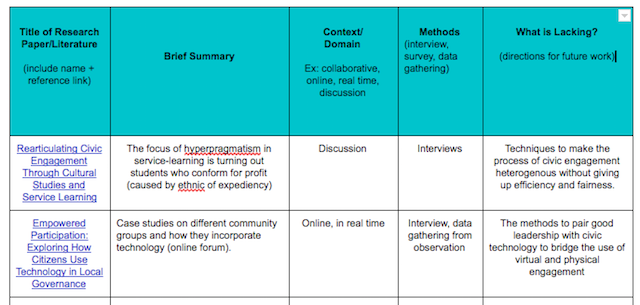
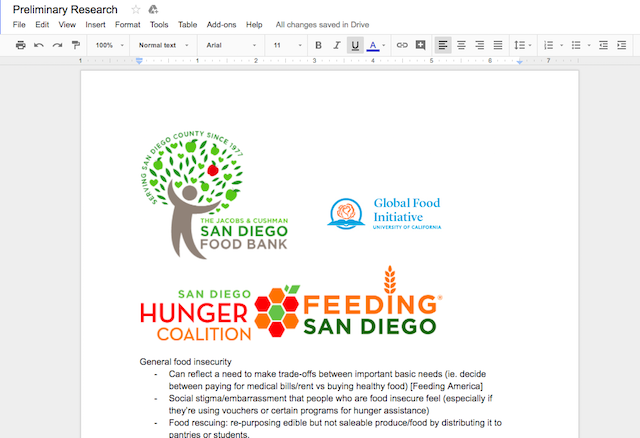
Research was conducted via browser searches, physical meetings, and reading exisitng articles on the topic. Individual research was conducted first to diversify the information and the team convened to understand bigger picture of student needs on campus.
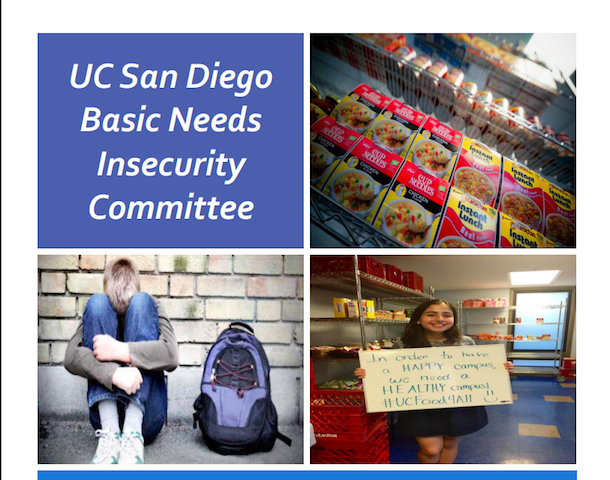
Team members participated in focus groups (no pictures of the event were allowed) Handwritten notes were taken at all of these events. I attended a "dinner and discussion" held by our on-campus Basic Needs Hub which aims to provide resources to students (including but not limited to food-based resources). This event allowed me to collect ideas from students on-campus who utilize these resources and can provide input about problems and potential solutions.
3. In-Person Interviews with Resource Center Leaders
Each member of the team contacted a coordinator who is part of food-based resources on-campus. I spoke with a coordinator at the Qualcomm Institute on campus who was working towards building an application that allows students to notify others when there is free/discounted food available on or near campus.
4. Cluster Analysis on Interview Data
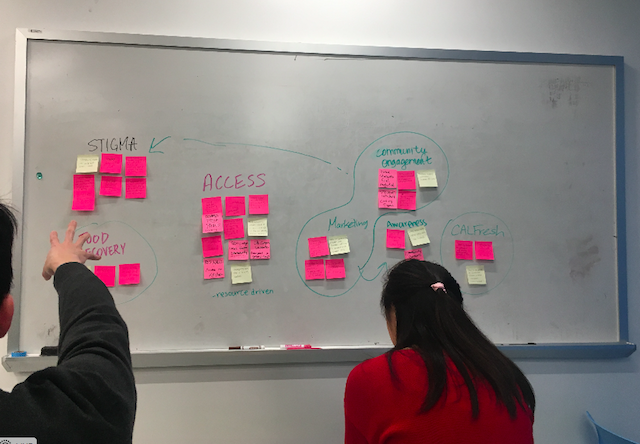
By using post-its, we identified strong or interesting points raised by our interviewees and grouped them with other points that were similar/address or introduce the same problem(s). From this, "How Can We" statements were created based on each cluster. We wrote two main How Can We's which includes: How can we increase awareness of food-based resources on campus? and How can we increase accessibility to healthy nutritious food?
5. End of Quarter Presentation and Critique
In 7 slides, our team presented our current findings and status to the entire DFA club. We explained our Immersion strategy which included interviewing people involved in the issue; we asked for help figuring out how we might be able to reach students who experience this first-hand while respecting privacy. From the session, we gained insight from our fellow club members on how we should move forward in the project. For example, a great point was brough up about working on an existing project as there are many on-campus!
6. Currently..
We are using the ideas formed through cluster analysis to better inform our solutions to tackling the "How Can We" statements. As a team, we decided to partner with the food pantry on-campus to choose a solution and have been communicating with their student manager for more information on constraints and other issues that we may encounter during the implementation process.
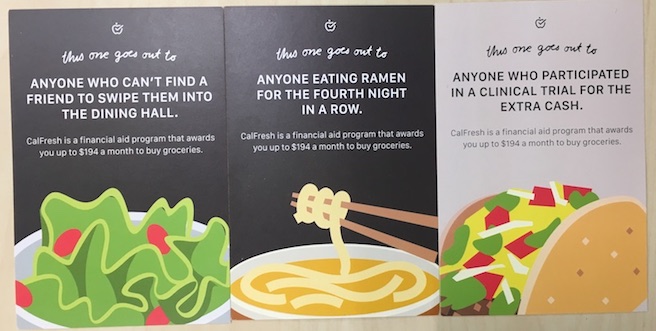
Our ideas include: an application which notifies students of food availability on-campus , increase consistent advertisement for food pantry events, and provide a shuttle service to bring students to off-campus locations which accept CalFresh.
1. Choosing Topic and Teams
DFA (short for Design for America) is an on-campus club which focuses on designing for social good. This year, our team is tackling Food Insecurity. As a group, a decision was made to focus on UCSD students (undergraduate, graduate, on-campus, and off-campus!) The team was created with diverse perspectives in mind; teammates are from fields such as Public Health, Computer Science, Economics, and of course, Cognitive Science HCI.
2. Preliminary Research on Topic
Research was conducted via browser searches, physical meetings, and reading exisitng articles on the topic. Individual research was conducted first to diversify the information and the team convened to understand bigger picture of student needs on campus.
Team members participated in focus groups (no pictures of the event were allowed) Handwritten notes were taken at all of these events. I attended a "dinner and discussion" held by our on-campus Basic Needs Hub which aims to provide resources to students (including but not limited to food-based resources). This event allowed me to collect ideas from students on-campus who utilize these resources and can provide input about problems and potential solutions.
3. In-Person Interviews with Resource Center Leaders
Each member of the team contacted a coordinator who is part of food-based resources on-campus. I spoke with a coordinator at the Qualcomm Institute on campus who was working towards building an application that allows students to notify others when there is free/discounted food available on or near campus.
4. Cluster Analysis on Interview Data
By using post-its, we identified strong or interesting points raised by our interviewees and grouped them with other points that were similar/address or introduce the same problem(s). From this, "How Can We" statements were created based on each cluster. We wrote two main How Can We's which includes: How can we increase awareness of food-based resources on campus? and How can we increase accessibility to healthy nutritious food?
5. End of Quarter Presentation and Critique
In 7 slides, our team presented our current findings and status to the entire DFA club. We explained our Immersion strategy which included interviewing people involved in the issue; we asked for help figuring out how we might be able to reach students who experience this first-hand while respecting privacy. From the session, we gained insight from our fellow club members on how we should move forward in the project. For example, a great point was brough up about working on an existing project as there are many on-campus!
6. Currently..
We are using the ideas formed through cluster analysis to better inform our solutions to tackling the "How Can We" statements. As a team, we decided to partner with the food pantry on-campus to choose a solution and have been communicating with their student manager for more information on constraints and other issues that we may encounter during the implementation process.
Our ideas include: an application which notifies students of food availability on-campus , increase consistent advertisement for food pantry events, and provide a shuttle service to bring students to off-campus locations which accept CalFresh.